How circadian rhythms shape the way we feel
Three quiet takeaways
- Circadian rhythms are the body’s daily timing system, set mostly by light and routine.
- Small misalignments — late screens, late meals, weekend lie-ins — quietly accumulate.
- You do not need a perfect schedule. You need a few stable anchors across the day.
For a long time I thought of time as something that happens around me. Mornings came when the alarm rang, evenings ended when I closed the laptop, and weekends were a soft reshuffle of all of the above. Then I started to notice that some weeks felt smoother than others without any obvious reason. The food was similar, the workload was similar, the weather was similar. What was different, I eventually realised, was the timing.
This article is a friendly tour of the internal clock that most of us carry without noticing. It is written from personal observations and from reading rather than from clinical practice. In my experience, even a basic awareness of circadian rhythms changes how a day feels.
I used to think of time as a fixed external grid. The week was a calendar, the day was a clock, and my job was to keep up. Now I think of time as more conversational. The clock is still there, but underneath it runs a slower, softer rhythm I can either work with or work against. The mornings that feel kind are the ones where I have remembered to listen.
What a circadian rhythm actually is
A circadian rhythm is a rough twenty-four-hour cycle that the body keeps. According to Harvard researchers, the cycle is driven by a small region of the brain that responds primarily to light and dark, but it also listens to meals, movement and social cues. When the cues line up, the day tends to feel steady. When they conflict, mornings drag and evenings buzz.
As WHO specialists note, our daily rhythms are shaped over a long time. They settle around the patterns we repeat: when we eat, when we are outside, when we look at screens, when we go to bed. The rhythms do not require perfection — they appreciate predictability.

Three big anchors
Light in the morning, movement during the day, dim and quiet in the evening. These three anchors tend to do more for the rhythm than any complicated plan.
What I noticed when I started paying attention
The first thing I changed was the morning. I opened the curtains as soon as I stood up. I drank water before coffee. I stepped outside for five minutes, even when the air was cold. After about ten days, my afternoons felt slightly clearer. I still had tired moments, but the "3 p.m. fog" was less heavy.
The second thing I changed was the evening. I stopped eating later than two hours before bed. I dimmed the kitchen lights after dinner. The phone moved out of the bedroom. None of this was dramatic. Together, the changes felt like a small renovation of the day.
“You do not have to fight the clock. You can negotiate with it.” — from a reader letter
A gentle weekly experiment
- Monday to Thursday: open curtains before the kettle, step outside once before lunch.
- Friday: a screen-free dinner with one candle and a slow conversation.
- Weekend: keep the wake-up time within one hour of the weekday rhythm.
- Sunday evening: a quiet review of the week with a paper notebook.
Social jet lag
Researchers describe the gap between weekday and weekend rhythms as social jet lag. Closing that gap by even an hour appears to support a steadier Monday for many people.
A few honest cautions
Not every tired week is a rhythm problem. Stress, life events and seasons all matter. The rhythm framework is helpful, but it is not the whole story. According to experts, it is best used as a quiet structure that supports other choices, not as a strict schedule that adds pressure.
If your work or family situation makes a steady rhythm difficult, focus on a single anchor first. Morning light is often the easiest win. Five minutes near a window before checking the phone is generally enough to begin.
Light as the main lever
If I had to choose one thing to keep, it would be the morning light. Stepping outside, even for two or three minutes, seems to anchor the day in a way that is hard to describe and easy to feel. The sky does not need to be sunny. Overcast daylight is still many times brighter than a well-lit kitchen, and the rhythm seems to notice the difference.
Evening light matters in the opposite direction. Bright overhead lamps after dinner appear to soften the boundary between day and night. A simple change — one floor lamp with a warm bulb instead of the ceiling fixture — can quietly reshape the way the body prepares for rest.
A small habit
Take one cup of tea or coffee outside, near a window, or on a balcony for a few minutes each morning. It is one of the most generous habits I have ever borrowed.
Author conclusion
Circadian rhythms are not a hack. They are the slow, friendly mechanism the body uses to organise our days. We do not need to study them deeply. We need to give them a few clear signals: light in the morning, movement during the day, calm in the evening. In my experience, those three quiet anchors do more for general well-being than any single dramatic change.
Read also
Join the slow-morning letter
Soft notes about gentle wake-ups, calm playlists, and warm rituals. Delivered every other Sunday.
Wake-up light: how a sunrise lamp actually works
Three quiet takeaways
- A wake-up light mimics a slow sunrise so the body starts shifting before the alarm sounds.
- The effect is subtle — not a fix, but a kinder signal than a loud buzzer.
- Placement, timing and your evening light all influence how well it works.
The first time I plugged in a wake-up light, I expected a gimmick. I had read mixed opinions online and assumed the device was a small lamp with marketing behind it. After two weeks, I noticed something quieter than I expected: I was already half awake when the soft chime arrived. Not energetic, not transformed — just less startled. For someone who used to bolt upright to an alarm, that was a small revolution.
This piece is not a sales note. It is a personal walk through what a wake-up light is, what it appears to do, and what to think about before you buy one. In my experience, the device is best understood as a quiet signal generator, not a magic switch.
How a sunrise lamp works
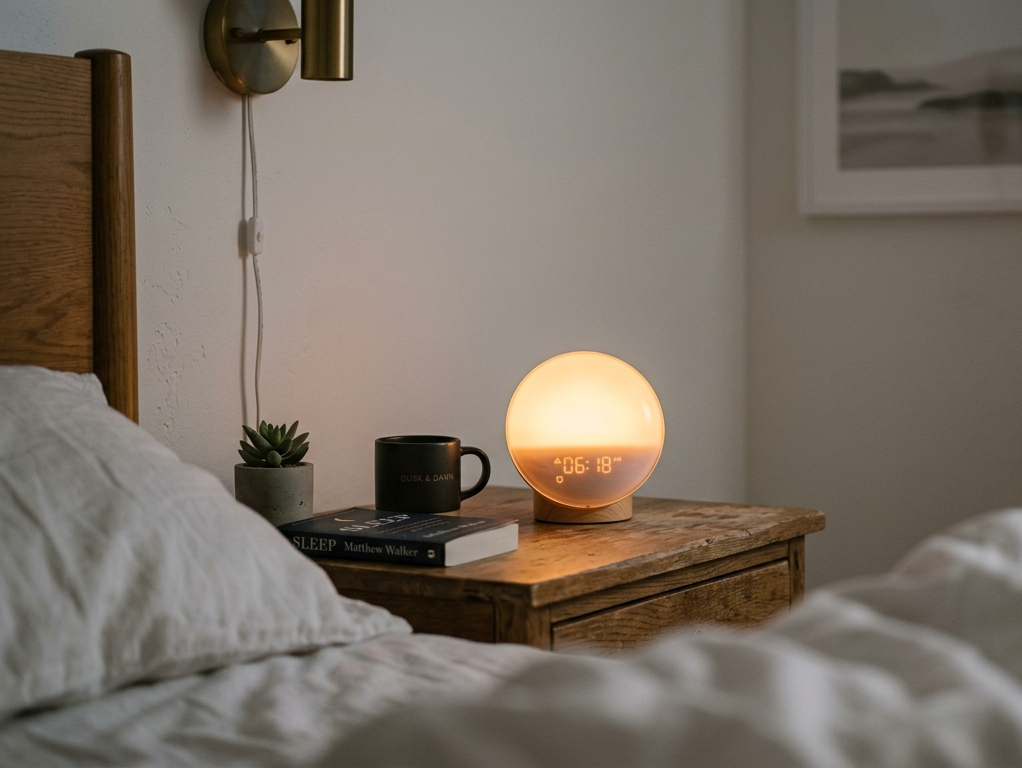
A wake-up light is, at heart, a lamp on a timer. The body of the lamp contains LEDs that gradually brighten over a chosen window — usually twenty to forty minutes — ending at the time you would like to be up. Many models start warm orange, then shift towards a cooler, brighter tone as the cycle progresses, imitating a slow sunrise.
According to Harvard researchers, light is one of the strongest cues our internal clock uses. When morning light arrives, it appears to support the body in shifting from rest mode into a wakeful state. A wake-up light tries to deliver that cue earlier and more predictably than a curtain that may or may not face the rising sun.
What it is not
A wake-up light is not a replacement for sleep, daylight or any kind of professional advice. It is a tool, and like any tool, it works best alongside other simple habits.
My personal setup
I keep my lamp about an arm’s length from the pillow, slightly above the headboard. I set the brightening curve to thirty minutes and choose the warmest target colour. The optional sound is a slow chime of birds that I turn down very low. The bedroom curtains are not blackout — they are linen, which lets a hint of true morning light join the lamp by the end of the cycle.
- Place the lamp slightly above eye level rather than at the foot of the bed. Indirect light reaches the closed eyelids more evenly.
- Keep the same wake-up time on most days. The lamp pairs well with consistency.
- Dim the evening. A bright bedroom at 23:00 will dilute the morning effect.
“The lamp does not wake me. It reminds my body that morning is coming.” — Elena, journal entry
What the research seems to suggest
Research indicates that gradual morning light may support a smoother shift out of sleep for many people, although results vary. As WHO specialists note, individual rhythms differ widely — some people respond strongly to light, others to temperature, others to sound. The wake-up light is one option in a small toolbox.
If you try one
Give it two full weeks. The first morning is usually unremarkable. Around day five, many people describe a softer feeling on waking. That feeling is the point.
Where it falls short
If your evenings are loud with screens and bright ceiling lights, the lamp may struggle to land. The morning signal works best when the evening signal has already begun winding down. The lamp will also not replace daylight: a short walk outside still seems to matter more than any device.
How I chose mine
There are many wake-up lights on the market and the prices vary widely. I did not buy the most expensive one. I looked for three features only: a curve longer than fifteen minutes, a target light that I could keep warm rather than blue, and a physical button I could press without my glasses. Everything else — apps, integrations, voice assistants — struck me as noise. A morning device should disappear into the bedroom, not invite my phone back into it.
I also paid attention to the bulb temperature. A lamp that ends in a cool blue tone may wake the body faster, but it can feel harsh after a calm evening. A warmer end tone — closer to candlelight than to office light — matched my preference for a softer start. Your preference might differ; that is part of the point.
One last small tip
If you share a bed with someone who wakes at a different time, point the lamp slightly away from the other pillow. The light is gentle, but it is still a signal, and a shared bedroom is a shared rhythm.
Author conclusion
A wake-up light is a small, kind, low-key piece of equipment. It will not transform a tired week, but it will probably make the morning landing softer. In my experience, that softness compounds. After a month, the alarm felt like a memory rather than a daily startle. If you are curious, start with a modest model, keep your evenings dim, and let the lamp do its quiet work for a couple of weeks before deciding.
Read also
Join the slow-morning letter
Soft notes about gentle wake-ups, calm playlists, and warm rituals. Delivered every other Sunday.
The first 30 minutes phone-free: a quiet experiment
Three quiet takeaways
- The first half hour after waking sets a tone the rest of the day quietly follows.
- Replacing the phone with a small ritual is easier than trying to use willpower alone.
- Two weeks is usually enough to feel a difference worth keeping.
My phone used to be the very first thing I touched in the morning — before the curtains, before water, sometimes before opening both eyes. The screen was small and bright. The information was loud. By the time I sat up, I had already absorbed twelve headlines, three messages and one mild worry. The day did not start; it landed on me.
The experiment in this article is simple. For the first thirty minutes after waking, the phone stays away. Not far away, not impossible to reach — just out of the bedroom. In my experience, this single shift made more difference than any morning routine I had read about online.
Why the first half hour matters
According to Harvard researchers, the brain in the first half hour after waking is uniquely sensitive. The body is recalibrating, the mind is soft, and attention has not yet found a target. Whatever lands first tends to set the emotional weather of the morning. A phone is excellent at delivering targets — usually targets we did not choose.
As WHO specialists note, attention is a limited resource. Spending it before breakfast on a feed designed to keep us scrolling appears to leave less for the things we actually care about. The early phone habit is not dramatic, but it is expensive in a quiet way.
What about the alarm?
Use a small clock or a wake-up light if you can. If the phone must be the alarm, place it across the room and switch it to airplane mode the night before.
A simple replacement ritual
The first time I tried this, I lasted four days. The fifth morning, I caved. Then I realised the problem was not willpower — it was the empty space. The phone was filling a slot, and removing it without a replacement created an awkward silence I could not sit with. The fix was to design a small ritual to take its place.
- Water first. A full glass before anything else.
- Light second. Curtains open, even on grey days.
- Three slow breaths. Standing, not lying down.
- One short note. A paper page, one sentence about the day ahead.
- Tea or coffee, made slowly. The kettle becomes the first soundtrack of the day.
“What you reach for first becomes a small vote for the kind of day you want.” — sticky note on my fridge
Two weeks in
After fourteen mornings, three things changed for me. Mornings felt longer in a good way. The first hour stopped vanishing into other people’s priorities. And the phone, when I finally picked it up, felt like a tool again instead of a habit. None of this is research — it is a personal experience. Yet most readers who try the same thing send a similar note within a fortnight.
If you slip
That is part of the experiment. Notice without scolding. The point is not perfection. The point is to grow a kinder reflex.
A few small notes
If you live with others, a quiet conversation helps. Tell partners or housemates that you are testing a phone-free half hour and ask them not to expect instant replies. If you have caring duties — small children, elderly relatives — keep the phone reachable but face-down and silent. The point is to remove the visual hook, not to disconnect from responsibilities.
According to experts who study attention, what we look at in the first minutes of waking influences the entire day’s focus pattern. That is a strong claim, and I cannot fully verify it on my own. But every time I have tried this experiment, the day that followed felt a little easier to navigate.
What the second hour looks like
Once the first thirty minutes are protected, the second hour of the day tends to take care of itself. I usually pick up the phone after I have eaten something small and stepped outside or near a window. The inbox is still the inbox. The world is still the world. What changes is the orientation of the person opening them.
I also try to choose what I look at first on the screen. Not the social feed, not the news app, but a specific message or list I had already planned to read. According to experts who study attention, this kind of first-target choice appears to ripple forward through the rest of the morning. In my own week, the difference is most visible on Mondays, when the workload is highest and the temptation to scroll is strongest.
A weekly tally
Once a week, jot down how many of the seven mornings stayed phone-free for the first half hour. The number does not have to be seven. Watching it climb is itself part of the practice.
Author conclusion
The first thirty minutes are short, and they are quietly powerful. A glass of water, a few breaths, one sentence in a notebook — this is not a routine that requires energy you do not have. It is a small invitation to a softer morning. In my experience, it is one of the simplest, kindest changes a person can make. Two weeks is enough to know whether you want to keep it.
Read also
Join the slow-morning letter
Soft notes about gentle wake-ups, calm playlists, and warm rituals. Delivered every other Sunday.